Quick Overview (TL;DR)
- 68% of US Google searches in 2026 end without a click (up from 45% in 2016). The pace is accelerating, driven mostly by AI Overviews. (Similarweb)
- Germany has the lowest zero-click rate (62%), and the UK has the highest (69.5%). EU regulations may be part of the reason European searchers still click more. (SparkToro)
- Google’s share of traffic to websites fell ~22% in a single year. Even among sites with professional SEO teams actively working on them. (Ahrefs)
- The first link inside an AI Overview performs like a 5th–6th place blue link. It’s Solid but not dominant. Top-3 blue links still win on raw clicks. (Saltbox Solutions)
- Being cited inside an AI Overview delivers 120% more organic clicks than appearing on the same page without a citation. Getting cited is now the goal. (Seer Interactive)
- To get cited by AI: put key content near the top, use specific data, write self-contained statements, and cite your sources. Traditional SEO still drives AI citations. (Cyrus Shepard)
- Most top-ranking pages aren’t as original as you’d think. The median page scores 52/100 on information gain. Half its content exists elsewhere on the same results page. Original data is the strongest differentiator. (On-Page.ai)
- Comparison and question queries trigger AI Overviews 86–95% of the time. If your content is built around “best of” or “X vs Y” pages, an AI Overview will almost always appear above you. (Seer Interactive)
- The SEO strategy shift: Stop chasing traffic as a KPI. Build brand, earn citations, own your audience (email list, community), and create content that’s worth quoting, even if no one clicks.
Well, first of let me be clear: I’m not an SEO expert, and neither do I have an impressive portfolio to showcase hidden SEO insights. However, I ran a few WordPress blogs for the last 7 years. I’ve seen a few ups & downs in the SEO industry.
In this blog, I compiled genuine SEO experts’ opinions on Zero-click searches and the future of SEO.
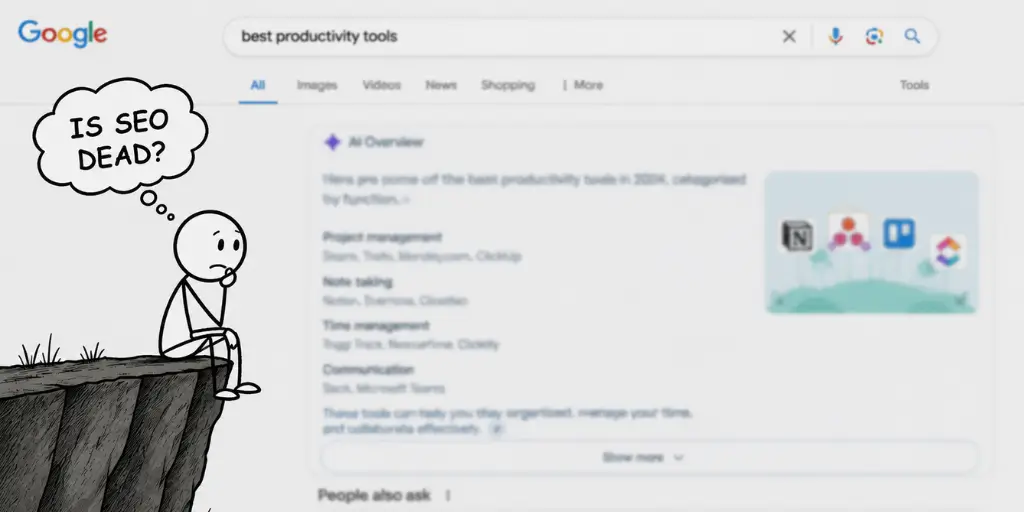
As you probably notice, more than 68% of Google searches end without a click. Thanks to Google AI overview.
While its good thing for users, they don’t have to search every website with ads and spammy affiliate links to find the right answer. But for website owners, it’s a nightmare. No visitors means no AdSense or affiliate income.
So, what can you do about it?
Here’s what the data says, why it’s happening, and what you can still do about it.
Most Google Searches End With Zero Clicks
In the first four months of 2026, 68% of Google searches in the US ended without a single click. Not just without clicking to a website, without clicking anything at all.
That means less than one in three searches sends anyone anywhere. The numbers show how dramatically things have shifted:
- In 2016: 45% of searches were zero-click.
- In 2019: it was 49%.
- In 2024: it crossed 60%.
- Now, in 2026, it’s 68%.
That’s a 23-point increase over a decade. And the pace is accelerating. The last two years alone saw a 7.5-point jump. That’s the fastest two-year increase ever recorded.
Why Is This Happening?
The biggest driver is Google AI Overviews.
Google’s AI-generated answer boxes now appear on more than 20% of all searches. When one shows up, top websites’ CTR (click-through rates) drop by nearly 60%.
Google answers the question right there. Users get what they need. They don’t need to click any website.
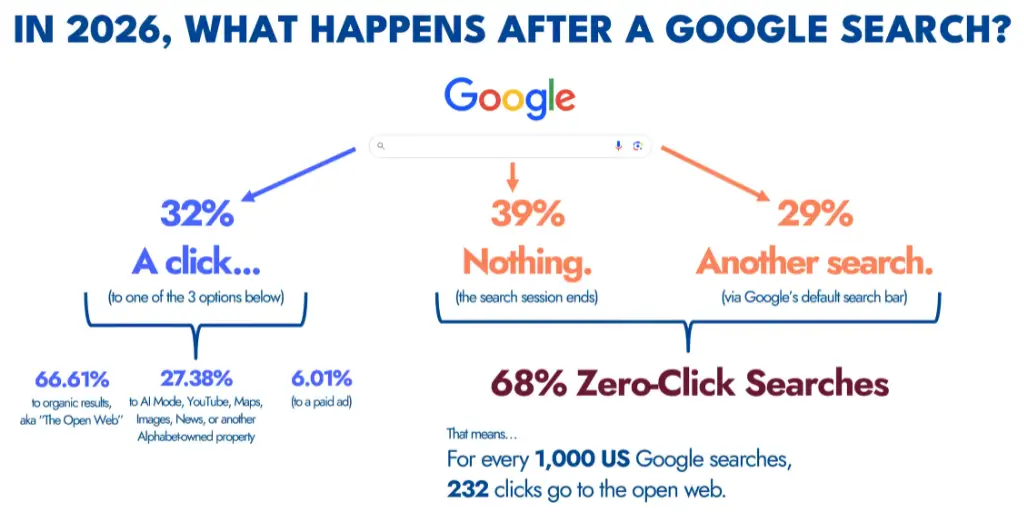
But AI Overviews aren’t the whole story. Google has been building toward this for years. Through featured snippets, knowledge panels, and instant answers, are designed to keep people on Google.
AI overview is just the latest and most powerful version of that strategy.
It works for Google financially. Their ad revenue has grown even as clicks to the open web have fallen. More searches happen. More ads get shown. More money flows in.
There’s also growing competition from social platforms and AI tools. About one in five searches now happens somewhere other than Google on YouTube, TikTok, Instagram, or ChatGPT.
How Bad Is the Traffic Loss?
Very bad, and getting worse.
Ahrefs tracked more than 75,000 websites over 12 months. These are sites with professional marketers actively working to grow traffic. In that period, Google’s share of traffic sent to those sites fell by about 22% in a single year.
Dozens of individual site owners have reported traffic dropping off a cliff. One site called AllAboutBerlin tracked an especially dramatic decline, even more steep than what aggregate studies show.
And if anything, these numbers are understated. The data doesn’t include searches made in Google’s mobile app, where zero-click features are even more aggressive
The Global Picture: Zero-Click Rate Per 1,000 Searches
Zero-click rates aren’t the same everywhere. SparkToro and Similarweb also looked at six countries. Here’s what they found:
| Country | Zero-Click Rate | Clicks per 1k Searches |
|---|---|---|
| UK | 69.5% | 232 |
| US | 68.0% | 231 |
| France | 65.3% | 271 |
| Canada | 63.8% | 268 |
| Italy | 63.4% | 280 |
| Germany | 62.1% | 287 |
Germany has the lowest zero-click rate. This may be connected to EU laws that penalize Google for self-preferencing behavior. The UK and US are nearly identical, both near the top of the zero-click range.
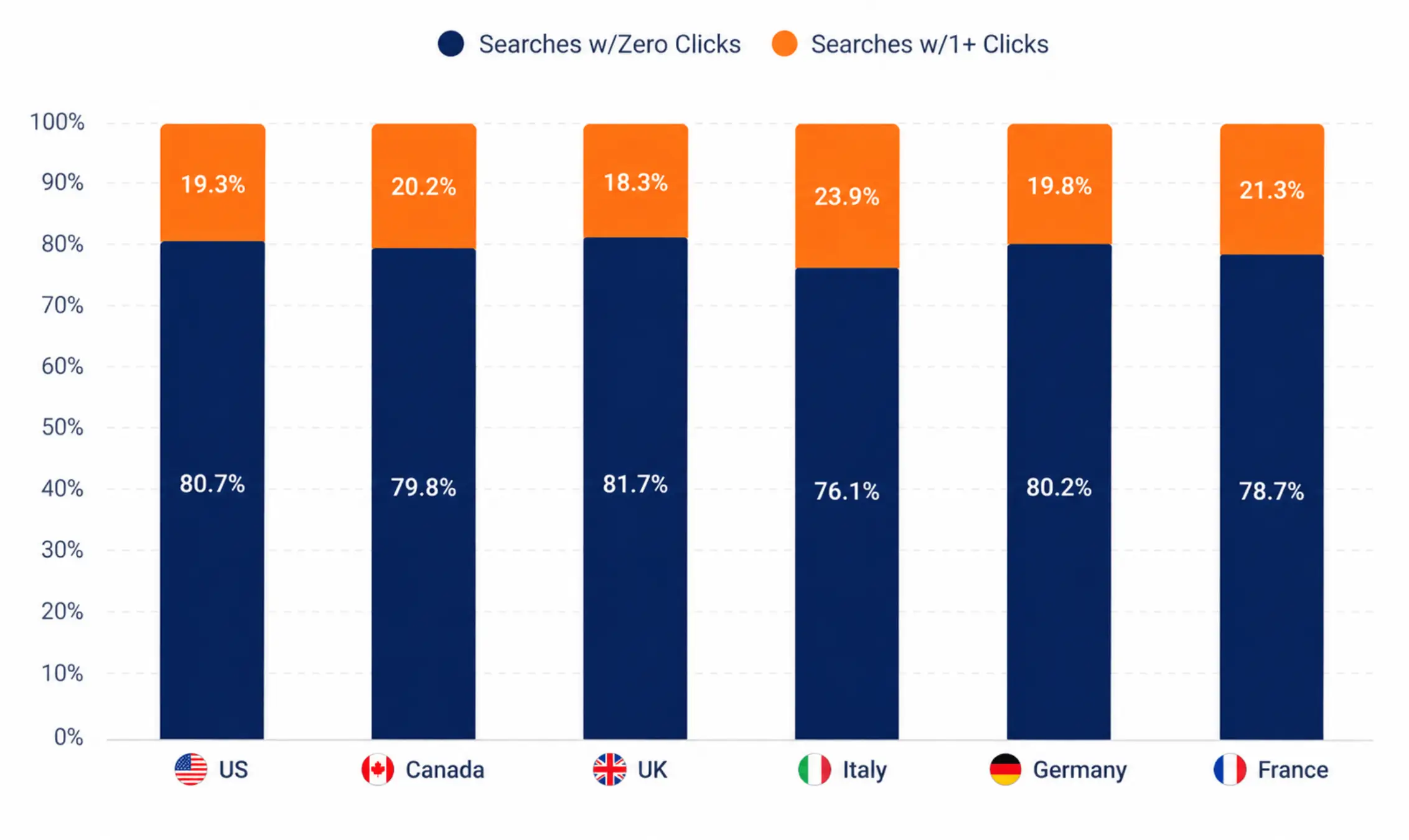
Canada’s position is interesting. Despite sharing a language and culture with the US and UK, Canadian searchers behave more like Europeans. Something else is clearly at play beyond just language.
No country in this study sends more than 300 clicks to the open web per 1,000 searches. We are in a zero-click world.
AI Overviews vs. Traditional Blue Links: Who Gets More Clicks?
If you do manage to appear in an AI Overview, does that help?
Research from Saltbox Solutions analyzed over 200 search results with AI Overviews, tracking click-through rates across industries. The verdict is nuanced.
- The first link inside an AI Overview performs about the same as ranking 5th or 6th in the traditional organic results. It’s nothing. But it’s not as good as a top-3 blue link.
- For raw clicks, traditional top-ranking results still win. Users scroll past AI Overviews to reach the links below. Especially for high-stakes decisions like health, finance, & major purchases. People want to verify sources with real data.
The bigger takeaway is this: a top 3 SERP ranking still outperforms any AI Overview position.
The Exception: Being Cited Inside an AI Overview
Here’s where things get interesting. Being mentioned (cited) inside Google AI Overview is very different from just appearing below one. Research from Seer Interactive tracked 53 brands across 5.47 million queries. Their findings:
- Being cited in an AI Overview delivers 120% more organic clicks per impression compared to appearing in results where you’re not cited.
- Brands that are not cited in an AI Overview, but appear on the same page, see organic click-through rates decline by 67%.
So the question is no longer just “how do I rank?” It’s “how do I get cited?”
The good news: organic click-through rates have started to recover in early 2026 after 18 months of decline. CTR climbed from 1.3% in December 2025 to 2.4% by February 2026 — an 85% rebound. Things may be stabilizing.
What Types of Searches Trigger AI Overviews?
Not all search queries are equally at risk. Seer Interactive’s data shows:
- Informational queries: AI Overview appears 36% of the time.
- Commercial queries: 8% of the time.
- Transactional queries: 5% of the time.
Within informational queries, the riskiest formats are:
- Comparison queries (“X vs Y”): AI Overview appears 95% of the time.
- Review queries: 86% of the time.
- Question format queries: 86% of the time.
- “Best of” queries: 81% of the time.
If your content is built around answering informational questions and comparisons, assume an AI Overview will appear. So, plan your content accordingly.
How to Get Cited by Google AI Overview?
If AI citations drive 120% more clicks, getting cited matters a lot. Cyrus Shepard at Zyppy analyzed 54 studies, experiments, and patents to identify what drives AI citations. Here are the top factors:
- Rank highly in traditional search: This is still the biggest lever to be cited by Google AI Overview. About 38% of AI Overview citations come from the top 10 Google results. If you win SEO, you’ll win AI citations easily.
- Put the most important content near the top. AI systems don’t read your whole page equally. They retrieve from the top first. Get to the point fast.
- Use clear structure. Headings, sections, and tables help AI extract and understand your content. Don’t force AI to hunt for your key points.
- Make your claims specific and factual. AI cites content that supports specific claims. “Adults need plenty of protein” is harder to cite than “Experts recommend 0.8 grams per kilogram of body weight.”
- Make your statements self-contained. Every key point should make sense on its own. Don’t rely on earlier paragraphs to provide context for later ones.
- Cite your own sources. Pages that show their evidence like data, references, & studies are more likely to be cited themselves.
- Keep your page accessible. If AI crawlers can’t read your page, they can’t cite it. Be careful with JavaScript-heavy pages and blocking settings.
Original Content Still Matters (But Differently)
A study from On-Page.ai measured 150 top-ranking pages across 50 keywords. They looked at “information gain” on how much unique information each page adds compared to other pages ranking for the same query.
The findings were surprising:
- The median top-3 page scored 52 out of 100. That means about half of its content already exists elsewhere on the same results page.
- 24% of top-3 pages add very little that isn’t already covered by competing pages.
- Only 21% of pages were highly original.
But here’s the key insight: pages with more original data points score much higher.
- Pages carrying 15 or more unique figures averaged a score of 62. Pages with one or fewer unique data points averaged 40.
- Content Length alone doesn’t help. Longer pages scored only modestly better. What matters is original evidence. You need to add your own research, your own numbers, your own first-hand findings.
- In 9 out of 10 search results analyzed, at least one common question from readers went unanswered by every page in the top 3. That’s a gap you can fill.
Who Is Still Winning in Google?
Some websites are still growing organic traffic despite all this. What do they have in common? Cyrus Shepard studied over 400 winning and losing websites. Five traits separated the winners:
- They sell a product or service: Not just information.
- They own proprietary assets: Original research, tools, data.
- They stay focused on a niche: Not trying to cover everything.
- They have a recognizable brand: People search for them by name.
- They let users complete a task: 84% of winning sites let you actually do something like buy, book, calculate, practice, etc.
The losers explained things and sent users elsewhere to act. The winners let users finish the job on-site. Having one of these traits barely helps. Winners with just one trait won only 15% of the time. Having four or five pushed that to 68-70%.
What Should You Do Now?
Here’s what the data suggests:
- Stop measuring traffic as your main KPI: Organic traffic is falling everywhere. That doesn’t mean your SEO & online marketing isn’t working. You need to build a correlation dashboard instead; track whether brand search, direct traffic, and revenue move together.
- Invest in brand: Branded searches still reliably drive clicks. AI systems also preferentially cite brands they recognize. Building a recognizable brand is one of the most durable moves you can make.
- Find the queries where AI Overviews don’t show: Non-AIO queries are getting better click-through rates over time. Organic CTR on those queries climbed from 2.9% to nearly 4% in 2025. These are topics Google can’t easily summarize. Build authority there.
- Optimize to get cited, not just to rank: Ranking matters, but being cited inside an AI Overview matters more. Use specific claims, original data, clear structure, and cited sources.
- Don’t abandon your website: Even as traffic falls, your content still shapes what AI systems say about you. A missing support article means Google’s AI Overview might get your facts wrong. Publish the clear, correct answer, even if you don’t get the click.
- Build outside your website too: Show up in newsletters, podcasts, social media, and communities where your audience already spends time. Earn mentions and citations from third-party sources. That’s the public record AI systems read before deciding whether to recommend you.
- Convert attention into owned assets: Social reach is rented. Turn it into an email list, a community, or first-party data. That’s the one thing platforms can’t take away.
The Bottom Line: Is SEO Dead?
Google is not going to stop this trend. The incentives are too strong. AI answers keep users on Google. More searches happen. More ads get shown. Revenue grows.
Ten years ago, 45% of searches were zero-click. Today it’s 68%. There’s no reason to think it won’t keep climbing.
But this isn’t the death of the web or the death of SEO. It’s a change in what SEO delivers. Ranking still influences what AI says about you. Being cited delivers real traffic. Original content and strong brands still win.
The click is becoming optional. Your strategy needs to account for that. You need to build a brand people search for by name, create content worth citing, and earn influence on platforms you don’t own.
That’s the new game. And the sooner you start playing it, the better positioned you’ll be.
Let me know what you think about this.
Thanks for reading. Have a nice day.